Why was the “Ctrl+Alt+Del” key created?

Adverts
A press the “Ctrl+Alt+Del” key It is, without a doubt, one of the most recognized shortcuts in the history of personal computing worldwide.
When your system crashes or needs immediate attention, your fingers instinctively reach for that life-saving combination on the keyboard.
But do you know the true origin of this command that has spanned generations of technology to reach 2025?
The story involves stressed engineers, rushed development, and a five-minute decision that changed everything.
Adverts
In this article, we will explore the behind-the-scenes creation of this shortcut, debunk urban legends, and understand its technical importance.
Get ready to discover how a simple reset code became a global cultural icon.
Summary:
- What motivated the invention of this iconic command?
- Who was the engineer responsible for the idea?
- What were the criteria for choosing these specific keys?
- How did this combination become standard in Windows?
- Why did Bill Gates criticize the choice years later?
- What is the technical and safety function today?
- Frequently Asked Questions (FAQ).
What motivated the invention of this iconic command?
In the early 1980s, IBM was racing against time to launch its first Personal Computer (PC).
The engineers faced constant software glitches during prototype testing of the machine.
Whenever the computer froze, the only solution was to turn off the power, wait for the system to cool down, and turn it back on.
This process, called hard rebootIt was slow and physically wore down the hardware components.
The team desperately needed a quick way to restart the system without cutting the machine's power.
The solution needed to be implemented via software, allowing developers to resume work in seconds.
It was this need for internal efficiency that gave rise to press the “Ctrl+Alt+Del” key as we know it today.
The initial goal was never to make this feature available to the end user, but rather to make life easier for programmers.
+ History of Floppy Disks, CDs, and USB Drives: How We Stored Files Before the Cloud
Who was the engineer responsible for the idea?
The "father" of this famous shortcut is David Bradley, one of the 12 original engineers who worked on the IBM PC project. He was responsible for writing the BIOS code, the basic input/output system.
Bradley revealed in several interviews that creating the code for the shortcut took only about five minutes. However, the decision of which keys to use was the result of careful ergonomic analysis.
He needed to ensure that the command was not accidentally triggered while the user was typing text or quick commands.
Such an error could cause the user to lose all their unsaved work in the blink of an eye.
Bradley's genius lay in transforming a complex technical problem into a simple and accessible solution.
His small contribution of code ended up surviving much longer than the original IBM hardware itself.
+ The origin of the word “bug” in computing and its most famous case
What were the criteria for choosing these specific keys?

The choice of press the “Ctrl+Alt+Del” key It wasn't random, but rather a decision based on the physical layout of the keyboard. On the original IBM PC (Model F) keyboard, the keys were strategically positioned.
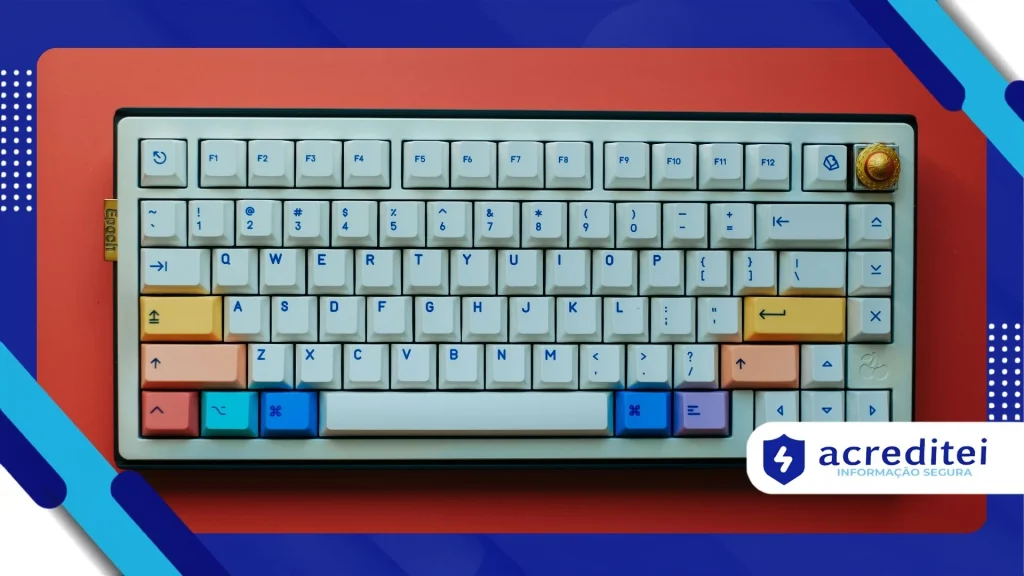
The “Del” (Delete) key was located on the opposite side of the keyboard from the “Ctrl” and “Alt” keys. This forced the user to use both hands to execute the system restart command.
This physical distance was an essential safety barrier to prevent accidental restarts during normal use.
Imagine the frustration of accidentally hitting the keyboard and seeing your computer restart on its own in the middle of a task.
Bradley had considered other combinations before, such as "Ctrl+Alt+Esc", but realized it was possible to press them with just one hand.
The user's job safety was the determining factor in the final choice of the combination.
+ How the internet worked before the invention of Wi-Fi
How did this combination become standard in Windows?
Although IBM created the hardware, it was Microsoft's operating system that popularized the shortcut worldwide.
In the beginning, the press the “Ctrl+Alt+Del” key It would simply restart the computer immediately, without questions or warnings.
With the arrival of Windows 3.xe, and later Windows 95, the function of the shortcut began to evolve.
Microsoft realized that users needed a way to close frozen programs without shutting everything down.
Thus, the command began to open a task management window, allowing specific processes to be completed.
This transformed the shortcut into an essential diagnostic tool for anyone using a computer.
Its popularity exploded because Windows, unfortunately, frequently crashed in older versions, requiring constant use of the shortcut.
The infamous "Blue Screen of Death" was often preceded by a desperate attempt to use the remote control.
To understand more about the evolution of operating systems and their interfaces, it's worth checking out this detailed article on the history of computing:
The History of Computing and the Evolution of the Graphical User Interface – TechTudo
Why did Bill Gates criticize the choice years later?
Interestingly, Bill Gates, the founder of Microsoft, has publicly expressed his regret regarding his leadership.
At an event at Harvard, he stated that if he could go back in time, he would have created a single button.
Gates explained that Microsoft's intention was to have a dedicated key for the "safe attention" function.
However, IBM, the hardware manufacturer at the time, did not want to add another button to the keyboard.
A press the “Ctrl+Alt+Del” key It was, therefore, a compromise solution between Microsoft software and IBM hardware.
Gates considers the three-key combination a "strange" design for such a critical and frequently used function.
Despite criticism, the complexity of the command system ultimately became a security advantage over the years.
The need for an intentional physical gesture prevents that malware Easily simulate logging into the system.
What is the technical and safety function today?
Today, in 2025, the shortcut plays a much more sophisticated role than simply restarting the machine.
In modern systems, it triggers what we call a "Safe Attention Sequence" (SAS).
This sequence assures the operating system that it is a real human being interacting with the computer.
Malicious software rarely manages to emulate this specific hardware signal to steal login passwords.
In addition to security, the command remains the primary gateway to the Windows Task Manager.
That's where we monitor CPU and RAM performance, and close unresponsive applications.
See below how the shortcut function has evolved across decades and system versions:
| Operating System Era | Main Function of the Shortcut | System Behavior |
| MS-DOS (1980s) | Soft Reboot immediate | It restarted without saving anything. |
| Windows 95/98 | Simple Task Manager | It allowed you to close frozen programs. |
| Windows NT/XP | Secure Login and Security | Screen lock and user switching. |
| Windows 10/11 (Current) | Complete Security Hub | Access to the Manager, Logoff, Lockout. |
A press the “Ctrl+Alt+Del” key It has proven to be a resilient tool, adapting to the new needs of cybersecurity.
Even with touch and biometric interfaces, physical controls retain their undeniable technical relevance.
To deepen your knowledge of information security and system shortcuts, I recommend reading this technical material from Microsoft:
Conclusion
The history of press the “Ctrl+Alt+Del” key It's a fascinating example of how temporary solutions can become permanent.
What began as a quick tool for IBM engineers has become a cornerstone of the user experience.
David BradleyEven unintentionally, he created a legacy that transcends code and enters pop culture.
The key combination represents the moment when we regain control of the machine when something goes wrong.
Even with advances in artificial intelligence and cloud computing, physical shortcuts remain essential.
They remind us that, behind complex software, there is still a fundamental layer of hardware and human interaction.
So, the next time you need to use this command, remember the story behind it.
You are repeating a technical skill that has saved millions of hours of work over more than four decades.
Frequently Asked Questions (FAQ)
Who invented Ctrl+Alt+Del?
IBM engineer David Bradley created the command in the early 1980s. He developed the code in about 5 minutes to aid in the development of the original PC.
Why didn't they just use one key?
The idea was to prevent accidental restarts. Using three widely spaced keys forced the user to use both hands, ensuring the command was intentional and preventing data loss.
Does the shortcut work the same way on a Mac?
No, Apple computers use different key combinations, such as "Command + Option + Esc," to force program closure. The architecture and operating system follow distinct logics.
Does Bill Gates like being in charge?
Not really. Bill Gates has stated in interviews that he would prefer to have a single dedicated button for security and login functions, considering the three-key combination a design flaw.
Is it still necessary to use this shortcut today?
Yes, the press the “Ctrl+Alt+Del” key It remains vital for security (secure login) and system management. It allows you to access the Task Manager and quickly lock your computer.