Do modern ultrawide monitors increase daily productivity?
Adverts
Invest in Modern ultrawide monitors It has become a central strategy for professionals and companies seeking to optimize workflow by eliminating visual bottlenecks in contemporary daily operations.
The transition from traditional multi-monitor setups to single widescreen displays has redefined the digital workspace, offering a continuous area for simultaneous management of multiple applications.
What characterizes a widescreen display and how does it revolutionize workflow?
Ultrawide monitors utilize expanded screen aspect ratios, such as 21:9 or 32:9, surpassing the traditional 16:9 format found in most conventional office displays.
This physical size allows you to view three full-size windows side-by-side, eliminating the constant need to switch tabs via keyboard shortcuts during complex tasks.
Adverts
The absence of central plastic borders creates a seamless immersive experience, reducing eye strain by keeping the user's focus centered on the primary work area.
Adopt Modern ultrawide monitors It simplifies the organization of the digital workspace, allowing you to track extensive spreadsheets, text documents, and corporate communication channels simultaneously with clarity.
How does screen curvature minimize eye strain during long work sessions?
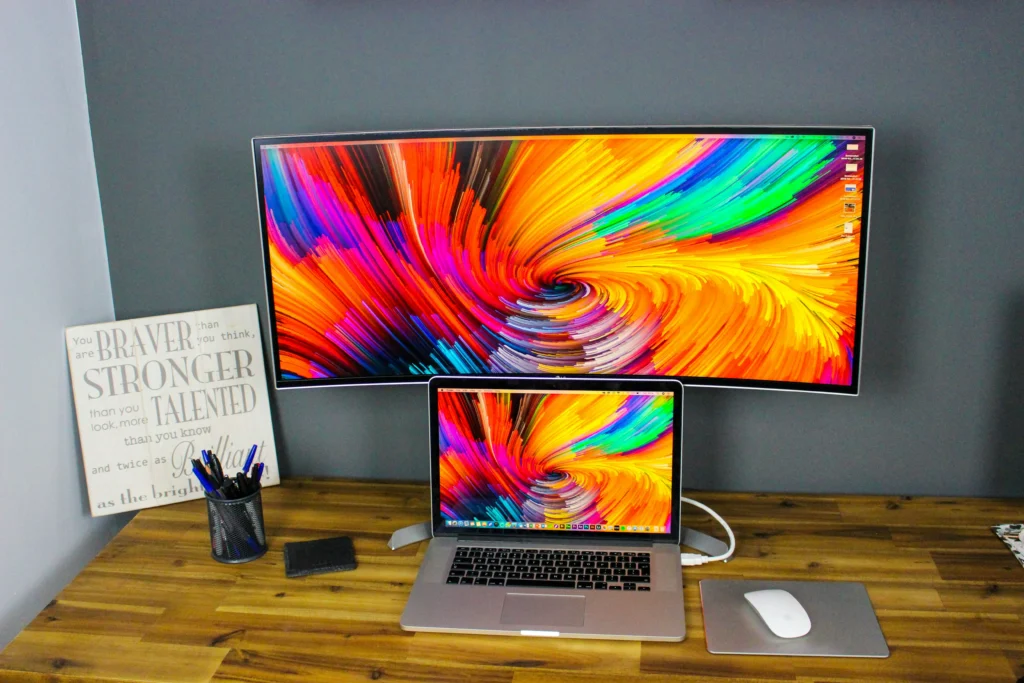
The introduction of curved panels with a radius of curvature between 1000R and 1800R follows the natural anatomy of the human field of vision during continuous reading.
This engineering ensures that the outer corners of the screen remain at the same focal distance from the user's eyes as from the center of the navigation panel.
As a direct result of this adapted geometry, the eye muscles work less to readjust focus when looking at the edges of the monitor throughout the day.
To consult international standards for workplace safety, office ergonomics, and occupational health, please visit [link/website address]. International Labor Organization (ILO).
Reducing physical strain on the operator preserves cognitive attention for longer, preventing tension headaches and neck discomfort caused by repetitive head movements.
What technical specifications differentiate the options available on the market today?
Choosing the ideal model requires analyzing the panel's native resolution, refresh rate, pixel density, and connectivity options integrated into the chassis.
Displays equipped with USB-C hub ports and support for fast charging via Power Delivery simplify cable management, powering notebooks through a single connection.
The table below compares representative models of widescreen displays available on the global market, highlighting crucial technical parameters for professional decision-making in 2026:
| Model and Proportion | Native Resolution | Radius of Curvature | Panel Technology | Ideal for professional use. |
|---|---|---|---|---|
| 21:9 Professional (34″) | UWQHD (3440×1440) | 1900R to 3800R | IPS with high DCI-P3 | Text editing, programming, and financial analysis. |
| 21:9 Curved Premium (38″) | WQHD+ (3840×1600) | 2300R | Nano IPS or QD-OLED | Graphic design, engineering, and video editing. |
| 32:9 Super Ultrawide (49″) | Dual QHD (5120×1440) | 1000R | VA or OLED | Replacing two 27-inch QHD monitors |
| 32:9 Master Category (57″) | Dual UHD (7680×2160) | 1000R | High-density mini-LED | Extreme multitasking and three-dimensional modeling |
Comparing these technical attributes allows you to select the equipment best suited to your operational needs, optimizing your financial investment and ensuring the longevity of your professional setup.
Why does software-based window management maximize operational efficiency?
Large screens require efficient software organization tools to segment the usable panel area into customized zones for daily work without overlapping.
Reputable manufacturers offer proprietary utilities that divide the display into predefined virtual grids, automatically fitting applications into place with a simple mouse drag on the desktop.
Read more: The end of internet cafes: why were they so popular?
Programmers can keep the open-source IDE at the center while monitoring the command terminal and technical documentation on the edges of the screen without interruption.
Integrate Modern ultrawide monitors With built-in KVM capabilities, it allows you to control two different computers using only one keyboard and mouse connected to the display.
When is replacing two monitors with a single screen recommended?
Replacing dual-monitor setups with a single panel is worthwhile when eliminating power cables and additional connectors is a priority on the desk.
Traditional dual headband configurations often position a thick plastic bezel directly in the user's field of vision, forcing improper neck postures throughout the day.
Know more: Universal USB-C connections are changing mobile devices.
The unified panoramic screen eliminates this physical obstacle, allowing you to position the main work window perfectly centered to maintain the correct ergonomic posture while typing.
To view global economic reports, analyses of labor productivity, and innovations in the technology sector, please consult the... World Economic Forum (WEF).
Simplifying the technical infrastructure of the workspace reduces system failure points, optimizes electricity consumption, and improves the visual comfort of the professional.
The consolidation of the modern work environment in 2026
Adopting high-resolution panoramic displays goes beyond the pursuit of visual aesthetics, establishing itself as a rational choice focused on work performance and ergonomic comfort.
Count on Modern ultrawide monitors It ensures that professionals navigate complex information flows with agility, maintain focus, and maintain a healthy attitude throughout the week.
Read more: The Best Camera Phones for Amateur Photographers in 2025
Assess your daily software needs, measure the available space on your desktop, and choose the right resolution to transform your digital work experience today.
FAQ (Frequently Asked Questions)
What is the ideal sitting distance from a 34-inch ultrawide monitor?
The recommended distance varies between 60 and 80 centimeters from the screen, ensuring that the entire field of vision encompasses the panel without requiring excessive neck movements.
Is it worth buying a flat ultrawide monitor instead of a curved model?
For 34-inch or larger models, curvature is highly recommended to avoid color distortion and loss of contrast at the side edges of the panel.
Do all computers and video cards support ultrawide resolution?
Most modern graphics cards and processors support these resolutions via DisplayPort or recent HDMI, but it's important to check your hardware specifications.
Does a 49-inch 32:9 monitor consume more power than two individual monitors?
In general, a single super ultrawide monitor consumes less electricity than powering two separate displays, and it only uses one wall outlet.