Interesting facts about modern satellites and the current global internet.
Adverts
Learning facts about modern satellites and the current global internet It reveals how aerospace engineering and telecommunications have transformed civil, corporate, and scientific connectivity in the year 2026.
Large constellations in low Earth orbit are replacing the old and distant geostationary systems, drastically reducing the response time of digital connections.
This infrastructural evolution ensures rapid network access on isolated oil platforms, commercial aircraft, and remote rural communities.
Our goal involves detailing the workings of these complex networks, propulsion innovations, and environmental impacts on contemporary astronomy.
Adverts
We will present real statistical data on orbital density and regulatory guidelines for mitigating space debris.
What are LEO constellations and how have they reduced the latency of global connections?
Traditional telecommunications infrastructure relied on devices positioned in geostationary orbit, located an impressive 35,786 kilometers above the Equator.
This massive distance created an unavoidable physical delay in signal transmission, making real-time interactive applications unfeasible.
New technology companies are circumventing this obstacle by positioning thousands of small devices in low Earth orbit, located between 500 and 1,200 kilometers from Earth.
This geographical proximity reduces latency to levels similar to those of residential fiber optics, optimizing video conferencing and financial transactions.
Collect comprehensive data. about modern satellites and the current global internet This allows us to understand that these spacecraft function in an integrated way, forming dynamic digital hives.
They continuously track ground terminals, invisibly transferring user data as they crisscross the sky at extremely high speeds.
How do intersatellite laser beams eliminate the need for constant ground stations?
Early generations of space-based internet required the satellite to be in simultaneous line of sight with the user and with a support antenna on Earth.
This technical limitation prevented coverage of deep oceans or polar regions lacking cable infrastructure connected to the network.
Modern spacecraft solve this problem by using laser optical communication links, allowing devices to communicate with each other directly in the vacuum of space.
This aerial data network transmits gigabits of information without needing to touch the ground until it reaches the final destination of the connection.
This technology speeds up international internet because light travels approximately thirty percent faster in a vacuum than in glass cables.
Consequently, space-based data routes outperform traditional terrestrial networks over long intercontinental distances.
To examine detailed data on space traffic management, monitoring of orbital debris, and international aerospace safety technical reports, consult the portal of United Nations Office for Outer Space Affairs (UNOOSA).
What are the performance metrics for the different orbital altitudes used today?
The efficiency of a space transmission system is directly related to its orbital parameters and the number of active devices.
To compare the performance characteristics of these different wireless transmission technologies, analyze the official consolidated data in the table below:
| Satellite Architecture Type | Average Operating Altitude | Average Latency Recorded | Proven Download Speed | Main Structural Advantage |
| Low Earth Orbit (LEO) | 550 km to 1,200 km | 25ms to 45ms | 100 Mbps to 220 Mbps | Ultra-low latency for civilian use. |
| Medium Orbit (MEO) | 8,000 km to 20,000 km | 120ms to 180ms | 50 Mbps to 150 Mbps | Extensive coverage with fewer devices. |
| Geostationary (GEO) | 35,786 km | 550ms to 700ms | 25 Mbps to 60 Mbps | Simplified static positioning |
Numerical indicators reveal why the research about modern satellites and the current global internet They focus almost entirely on low-altitude models.
Although they require massive investments to deploy thousands of modules, the operational benefits of speed outweigh traditional approaches.
Why are krypton or argon gas ion thrusters essential for orbital sustainability?
Maintaining a spacecraft correctly positioned in low orbits requires frequent course corrections due to the subtle atmospheric drag remaining in that region.
Aerospace engineers utilize highly efficient ion thrusters based on the electrostatic acceleration of heavy noble gases, such as krypton and argon.
These engines generate extremely precise impulses while consuming minimal amounts of fuel over operating cycles that last for several consecutive years.
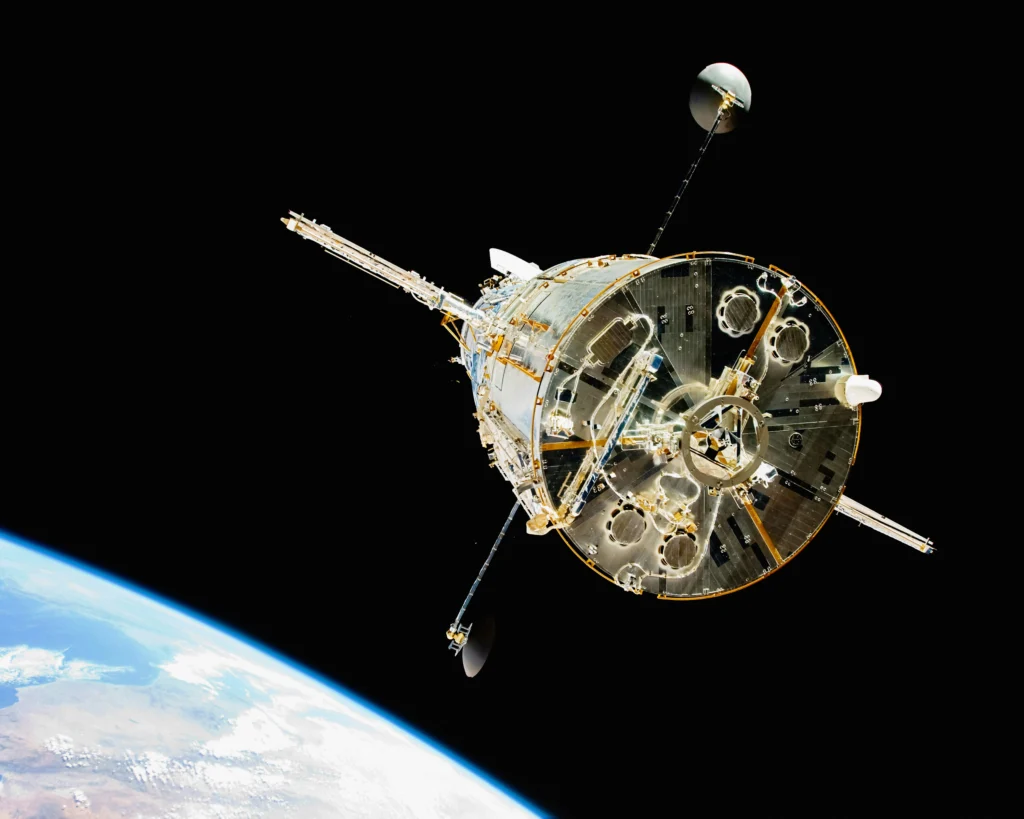
This weight saving makes it possible to produce smaller, cheaper, and easier-to-transport devices in reusable rockets.
Read more: Evolved Internet of Things: smarter homes and cities
The most important feature of these electric motors involves the ability to force the planned deactivation of the equipment at the end of its useful life.
The satellite gradually reduces its own altitude until the heat of the Earth's atmosphere safely destroys its structure completely.
When did the proliferation of megaconstellations begin to interfere with astronomical research?
The international scientific community is expressing growing concern about the increased nighttime glare caused by solar reflection on the panels of commercial space fleets.
Bright trails captured in long-exposure photographs damage valuable data from ground-based telescopes dedicated to mapping the deep universe.
Read more: Interesting facts about submarine cables that connect the internet.
Manufacturers are responding to this challenge by installing dark deflecting films and directional mirrors designed to divert sunlight away from the ground.
This visual attenuation engineering attempts to balance the need for global connectivity with the right to study the cosmos without artificial barriers.
The Future of Space Connectivity and Democratic Access to Information
The consolidation of high-capacity space networks represents a fundamental milestone for universalizing knowledge and including vulnerable populations in the digital economy.
Eliminating traditional geographical barriers allows essential telemedicine and education services to reach the most isolated parts of our planet.
Continuous technological advancements ensure that the coming years will bring even smaller, more powerful, and less harmful equipment to the nighttime environment.
Know more: How Satellites Capture Your Photos from Space — and Why It Matters
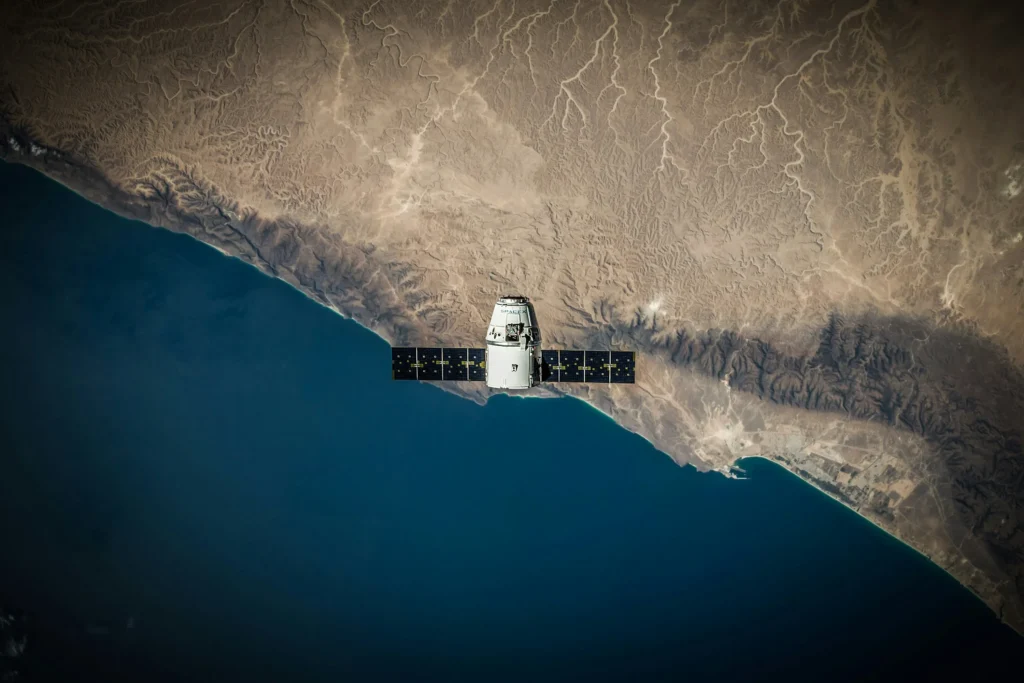
By integrating technical innovation, operational responsibility, and global governance, we ensure that outer space remains useful for all of humanity.
To explore mobile connectivity statistics, electromagnetic spectrum reports, and telecommunications regulations in Brazil, access the official database of [website/organization name]. National Telecommunications Agency (Anatel).
Frequently Asked Questions (FAQ)
How do receiving antennas on Earth manage to track satellites that are moving so fast?
Modern antennas utilize electronically controlled phased array technology, eliminating the need for heavy, physically driven motors.
The equipment directs the reception beam by altering the response times of hundreds of small elements integrated into the surface of the home receiver panel in milliseconds.
What happens to the space internet signal during storms or heavy rain?
Water in the atmosphere absorbs high radio frequencies, a meteorological phenomenon known in the telecommunications engineering sector as rain attenuation.
Space routers compensate for this momentary power loss by dynamically adjusting frequencies to keep the user connected even in adverse conditions.
What is the real risk of a chain collision rendering low Earth orbits unusable?
This hypothetical scenario of successive impacts, scientifically known as Kessler Syndrome, is rigorously monitored by automated artificial intelligence systems.
Modern spacecraft possess automatic diversion algorithms that instantly alter their course upon detecting any object approaching at dangerous distances.
Could satellite internet completely replace traditional fiber optic networks?
Space-based internet acts as a complement to, and not a replacement for, terrestrial submarine fiber optic cable systems.
Orbital constellations are ideal for connecting geographically difficult-to-reach regions, while coastal cables support the massive traffic of large metropolitan areas.