The use of digital twins in Brazilian urban infrastructure.
Adverts
The implementation of digital twins This represents the boldest step towards modernizing public administration and urban planning in present-day Brazil.
This technology, which creates dynamic virtual replicas of physical assets, is no longer a futuristic promise. By 2026, it will be established as an essential tool for mayors and engineers.
Brazilian cities face historical challenges that demand immediate and precise solutions, ranging from basic sanitation to complex urban mobility.
The use of digital twins allows for the simulation of catastrophic or growth scenarios before laying the first brick.
Adverts
Municipal managers can now visualize the impact of a new avenue on local traffic or predict floods with millimeter accuracy.
Integration with the Internet of Things (IoT) feeds these models with real-world data continuously.
In this article, we will explore how this innovation is reshaping the national efficiency map and which cities are already leading this movement. You will understand the technique behind the magic and the real benefits for society.
Summary:
- What are digital twins in the context of smart cities?
- How is this technology transforming public administration in Brazil?
- What are the main advantages for urban sustainability?
- Comparative table: Traditional Planning vs. Digital Twins
- What are the technical and budgetary challenges for implementation?
- What can we expect from the future of smart cities in Brazil?
- Conclusion
- FAQ (Frequently Asked Questions)
What are digital twins in the context of smart cities?
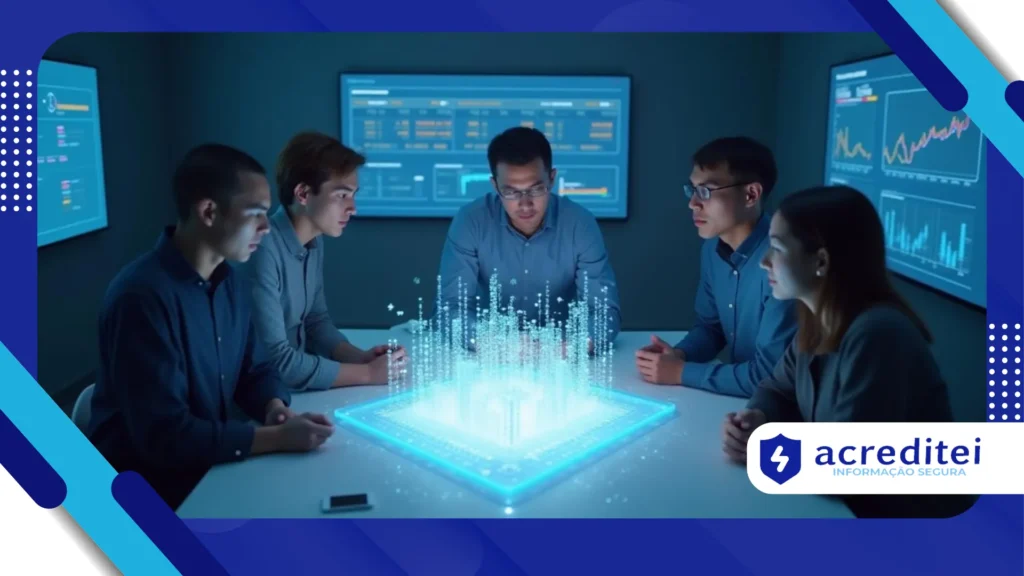
A digital twin is not just a sophisticated 3D model or a static drawing made in conventional architectural software. It functions like a living organism, directly connected to its physical counterpart in the real world.
Sensors scattered throughout the city collect information on temperature, vibration, vehicle flow, and energy consumption in real time.
This data feeds into the virtual model, which reacts and adapts instantly to the changes detected.
Technology uses artificial intelligence to process this massive volume of information, known as Big Data, generating valuable predictive insights. Engineers can anticipate failures in viaducts or power grids before a collapse occurs.
In the Brazilian context, the adoption of digital twins It integrates deeply with the concept of BIM (Building Information Modeling). This union ensures that public works are born digitized from the project conception phase.
Urban management platforms use this foundation to create an ecosystem where every lamppost, drain, or traffic light has a digital identity. This facilitates maintenance and drastically reduces the operational costs for municipalities.
+ Embedded technologies in budget-friendly home appliances
How is this technology transforming public administration in Brazil?
Brazil has made significant progress in the practical application of these tools, moving beyond the phase of isolated pilot projects observed at the beginning of the decade. Major cities like Curitiba and Rio de Janeiro are using models for climate monitoring.
Managing natural disasters has become a priority focus for the application of this technology in the country.
Advanced hydraulic simulations help predict the behavior of watersheds during extreme summer rainfall.
Authorities are able to issue early warnings with greater accuracy, saving lives and minimizing material losses in mapped risk areas.
Emergency response becomes proactive, based on scientific data and not just on belated reactions.
In urban mobility, smart traffic lights connected to digital twins They adjust their opening times according to the actual flow of cars. This reduces chronic congestion without the need to build new lanes or overpasses.
The sanitation sector also benefits from the remote detection of leaks in old underground pipelines. Utility companies reduce the waste of drinking water, an increasingly scarce and valuable resource in the country.
To deepen your understanding of how connectivity drives these innovations, Read this report from ABDI (Brazilian Agency for Industrial Development). Regarding digital maturity in civil construction and infrastructure.
What are the main advantages for urban sustainability?
Sustainability is no longer a vague discourse and is gaining tangible metrics through the virtualization of urban processes. Reducing the carbon footprint is a direct consequence of optimizing energy and logistical resources.
Public buildings monitored by digital twins automatically adjust their air conditioning and lighting systems. Energy consumption drops drastically, easing the burden on public coffers and reducing demand on the national electricity grid.
Planning routes for solid waste collection becomes dynamic, saving fuel for the truck fleet. Fewer vehicles on the road unnecessarily means less emission of polluting gases into the atmosphere of large metropolitan areas.
The durability of infrastructure increases considerably with predictive maintenance made possible by... digital twins. Repairing a crack in a bridge before it becomes a structural fissure saves millions in reconstruction costs.
Construction materials are used more rationally, avoiding the waste common in traditional construction sites. The circular economy gains strength, as the digital model tracks the complete life cycle of materials.
+10 cybersecurity practices for small businesses to avoid attacks
Comparative Table: Traditional Planning vs. Digital Twins
Below, we present real data on operational efficiency comparing conventional methods with digital twin-based infrastructure management.
| Evaluation Criteria | Traditional Urban Planning | Planning with Digital Twins | Actual Impact Observed |
| Fault Detection | Reactive (after the problem occurs) | Predictive (before failure) | Reduction of 30% in emergency repair costs. |
| Decision Making | Based on static historical data | Based on real-time data | A 40% increase in crisis response agility. |
| Energy Management | Manual or programmed adjustments | Automation via IoT and AI | Average savings of 20% in public buildings. |
| Data Integration | Isolated silos (departments don't communicate) | Unified and integrated platform | Elimination of data redundancy in 50%. |
| Scenario Simulation | Limited and time-consuming | Immediate and multi-scenario | Reduction of 25% in project approval time. |
What are the technical and budgetary challenges for implementation?
Despite the clear benefits, the massification of digital twins In Brazil, this encounters significant barriers that require attention.
Connectivity infrastructure, although it has evolved with 5G, still has shortcomings in peripheral regions.
The initial cost of implementing sensors and data processing software may scare managers with tight budgets. The return on investment is guaranteed in the long term, but requires strategic political vision.
The shortage of skilled labor to operate these complex platforms is another bottleneck faced by the national market. Universities and technical courses need to accelerate the training of professionals capable of working with BIM and IoT.
Issues related to data privacy and security also pose challenges to the widespread adoption of these monitoring technologies. The General Data Protection Law (LGPD) must be strictly respected to avoid excessive surveillance.
Interoperability between different legacy systems used by city governments hinders the creation of a unified vision for the city. Integrating databases from decades past with cutting-edge technologies requires a monumental IT effort.
+ The future of robotics and its growing presence in companies.
What can we expect from the future of smart cities in Brazil?
The horizon for smart cities in Brazil points towards total integration between citizens and urban infrastructure. Mobile applications will allow the population to interact directly with the digital twin of their city.
Citizens will be able to report problems or suggest improvements, which will be simulated virtually before any official approval.
Popular participation gains a powerful technical tool, democratizing decisions about shared urban space.
Generative artificial intelligence will begin to propose autonomous architectural solutions for problems detected by sensors.
The system could suggest, for example, the redesign of a dangerous intersection based on accident patterns.
We will see the expansion of digital twins for medium-sized cities, not just being restricted to large capitals. The reduction in IoT hardware costs will facilitate this reach throughout the interior of the country.
Brazil has the potential to become an exporter of tropicalized urban technology solutions, adapted to complex realities. Our innovations in water resource management and public transportation can serve as a global model.
Conclusion
The silent revolution brought about by digital twins is rewriting how we live and interact with urban space. It's not just about technology, but about dignity, safety, and efficiency for the population.
Adopt digital twins It is a commitment to fiscal and environmental responsibility, ensuring that every penny invested returns in quality of life. Brazil in 2026 is moving, albeit with challenges, towards a more connected future.
Municipalities, businesses, and citizens must collaborate to overcome the technical and cultural barriers that still exist. The transparency brought about by real-time data is the foundation of a modern and functional democracy.
To follow the official government guidelines on infrastructure digitization, visit the [link/reference]. Brazilian Strategy for Digital Transformation on the Gov.br website. The future is now, and it's digital.
FAQ (Frequently Asked Questions)
What is needed for a city to implement a Digital Twin?
The city needs a robust data collection infrastructure (IoT sensors), stable connectivity (fiber optics or 5G), and a software platform capable of processing Big Data and integrating BIM models.
Do Digital Twins replace the work of engineers and architects?
No, they enhance the work of these professionals. Technology provides accurate data so that engineers and architects can make more informed decisions, eliminating guesswork and reducing calculation errors in complex projects.
What is the difference between BIM and Digital Twin?
BIM (Building Information Modeling) focuses on the modeling and information of physical construction. Digital Twin uses BIM as a foundation, but adds a layer of real-time data and dynamic interaction.
Does the use of this technology increase the cost of public works?
Initially, there is a cost associated with technological implementation. However, the savings generated by early error detection, waste reduction, and optimized maintenance make the project cheaper over its lifespan.