
The first message sent over the internet changed communication.
Adverts
A First message sent over the internet It marked the birth of the digital age, forever transforming the way humanity shares information, produces knowledge, and establishes global connections.
The historic feat occurred in October 1969, when pioneering scientists linked two distant computers, establishing the first communication node of the ancestral network known as ARPANET.
Although the initial test encountered unforeseen technical glitches, the successful transmission of the first letters proved the practical feasibility of long-distance data packet switching.
Understanding the origins of this technical infrastructure allows us to appreciate the evolution of modern networks, from rudimentary university terminals to the global hyperconnectivity we experience daily in contemporary society.
What was ARPANET and how did the pioneering transmission come about?
Funded by the U.S. Defense Advanced Research Projects Agency, ARPANET was created to connect academic and military computers in a decentralized and resilient network.
The innovative architecture replaced dedicated telephone circuits with packet-switching technology, dividing files into small digital fragments that traveled independently to their final destination.
Engineers and researchers from the University of California, Los Angeles (UCLA) worked together with Stanford University to conduct the first practical test of the communication system.
This decentralized approach ensured that the network remained operational even if individual nodes failed, establishing the conceptual foundation that underpins the entire global internet infrastructure today.
How was the message sent, and what was the system error?
On October 29, 1969, student Charley Kline attempted to type the word "LOGIN" into the UCLA terminal to access the Stanford laboratory computer.
The system successfully transmitted the letter “L” and the letter “O”, but suddenly crashed when the third letter “G” was sent by the university network operator.
Despite the server crash, the partial "LO" transmission recorded the First message sent over the internet, becoming an undeniable symbolic landmark of modern computer engineering.
After making the necessary technical adjustments to the computer's memory, the team repeated the operation about an hour later, completing the word in its entirety without further errors.
Historical Timeline of the Evolution of Digital Messaging
| Year of the Event | Technological Milestone | Main players / Institutions | Impact on Global Communication |
|---|---|---|---|
| 1969 | Transmission of the text “LO” | UCLA and Stanford (ARPANET) | Birth of packet switching |
| 1971 | Creating your first email | Ray Tomlinson (BBN) | Introduction of the “@” character for addressing |
| 1983 | Adoption of the TCP/IP protocol | ARPANET / Military | Universal standardization of computer networks |
| 1991 | Launch of the World Wide Web | Tim Berners-Lee (CERN) | Popularization of hypertext browsing |
Why did packet switching revolutionize data transmission?
Before computer networks, long-distance communication relied on circuit switching, which kept a physical telephone line occupied exclusively for the duration of the call.
Packet switching has enabled multiple users to share the same cabling simultaneously, optimizing traffic and reducing operating costs for research institutions and businesses.
Read more: Offline translators for mobile phones that work without internet.
Each data packet contains headers with source and destination addresses, allowing smart routers to find the fastest and safest path through the network infrastructure.

Consult the historical collection maintained by Computer History Museum to examine original documents, period photographs, and technical records of the first ARPANET connections.
What were the immediate consequences following the successful test?
The success of the experiment accelerated the expansion of ARPANET, integrating dozens of universities, government research centers, and private laboratories in the United States over the following years.
The invention of email in 1971 by Ray Tomlinson transformed the network from a remote processing tool into a practical channel for daily personal correspondence.
Know more: How to measure your real internet speed
The adoption of the TCP/IP protocol in 1983 unified different local area networks under a standardized technical language, allowing the definitive transition from ARPANET to the modern commercial internet.
Analyze the First message sent over the internet It demonstrates how academic collaboration and investment in basic research have shaped the fundamental digital tools of our daily lives.
When did web browsing make communication accessible to the public?
Despite the growth of academic networks during the 1970s and 1980s, access to information remained restricted to specialists capable of operating complex terminal commands.
The creation of the World Wide Web at CERN by Tim Berners-Lee introduced visual browsers and hyperlinks, democratizing access to online content pages for ordinary users.
Read more: The origin of the at symbol (@) long before the modern internet.
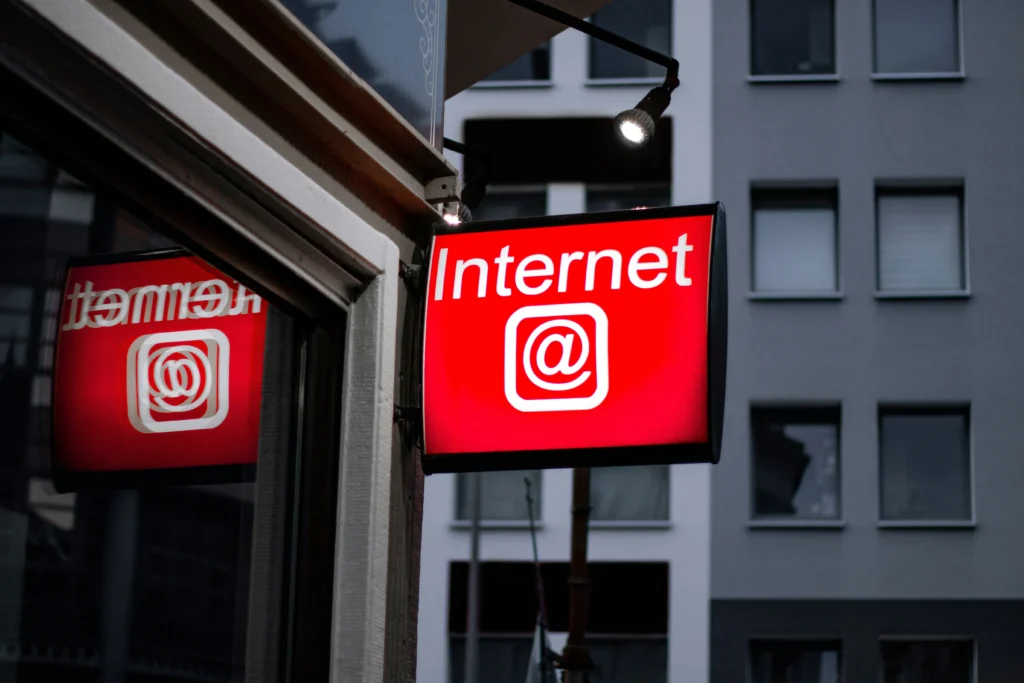
From that point, simple text messaging rapidly evolved into multimedia transfers, interactive blogs, social media platforms, and real-time instant messaging ecosystems.
Access the portal of Internet Society (ISOC) to understand the history of network development and the global guidelines for the future governance of the web.
Frequently Asked Questions (FAQ)
Who were the people responsible for submitting the first online registration?
Student Charley Kline operated the terminal at UCLA under the direct supervision of Professor Leonard Kleinrock, while Bill Duvall received the transmission in the Stanford laboratory.
What computer was used in the UCLA laboratory in 1969?
The UCLA team used an SDS Sigma 7 mainframe computer, connected to an interface message processor (IMP), which functioned as the first router in history.
Where is the original location of the first transmission?
UCLA's Laboratory 3420, where the message was sent, has been preserved and transformed into the Boelter Hall Research Center, open for visits by students and historians of technology.
How does ARPANET differ from the modern World Wide Web?
ARPANET was the physical and protocol network infrastructure, while the World Wide Web is an application layer that organizes content into pages linked by hyperlinks.
A First message sent over the internet It paved the way for the information revolution, redefining the economic, social, and cultural structures of humanity. From that modest "LO" typed on an academic terminal to today's complex global data flows, the quest for faster and more efficient connections continues to drive the advancement of civilization.