Origin of push notifications used in millions of mobile phones
Adverts
Investigate the origin of push notifications It reveals how an innovation in server architecture has transformed mobile communication, enabling the instant sending of alerts to millions of devices.
Before this revolutionary architecture, cell phones constantly had to query servers to check for new emails or messages, consuming battery and mobile data in an extremely inefficient way.
The emergence of cloud messaging services has radically altered this scenario, establishing a permanent and low-consumption connection channel between central servers and mobile operating systems.
Understanding this technological evolution allows us to understand how the immediate delivery of data has shaped user behavior, the application economy, and global software engineering.
Adverts
What are push notifications on mobile phones, and what is their historical origin?
This technology involves the direct delivery of information sent from a remote server to the end device without the need for an active request from the application.
The pioneering concept emerged in the late 1990s with BlackBerry, which introduced instant push email on its corporate devices using dedicated integrated servers.
The mass popularization of modern smartphones occurred in June 2009, when Apple launched the... Apple Push Notification service (APNs) in the iOS 3.0 operating system.
Google followed the same strategic path in 2010, launching the Android Cloud to Device Messaging (C2DM), later updated to Google Cloud Messaging and currently named Firebase Cloud Messaging.
How does the technical architecture behind sending instant alerts work?
The operation of this infrastructure is based on maintaining an open, very low-power TCP socket between the mobile phone's operating system and the platform's servers.
When an application sends a message, the application server dispatches the encrypted content directly to the central messaging service of Apple, Google, or Microsoft.
| Platform / Service | Release Year | Main Protocol Used | Main Function in Architecture |
| BlackBerry Push Email | 1999 | PIN-to-PIN / BES Protocol | Instant delivery of corporate emails |
| Apple APNs | 2009 | HTTP/2 and TLS Encrypted | Sending visual and audio alerts on iOS |
| Google C2DM / FCM | 2010 | HTTP v1 / XMPP Protocol | Data routing and notifications on Android |
| Web Push Standards | 2015 | W3C Push API / VAPID | Direct notifications in mobile web browsers |
Detailed documentation on connectivity standards and mobile network protocols is maintained and updated periodically by World Wide Web Consortium, a global standardization body.
Understanding origin of push notifications It helps to understand the importance of saving hardware resources in the portable devices we use daily.
Without the unified channel provided by operating systems, each application would need to keep its own service running in the background, draining the phone's battery in just a few hours.
This centralized model optimizes device processing by receiving compressed data and waking up the specific application only at the exact moment the information arrives.
Why did push technology replace the old continuous request model?
The traditional model known as polling It required the application to establish periodic connections with the server every five or ten minutes to check for updates.
This continuous process generated a massive waste of data traffic and kept the smartphone's processor operating at high frequencies, constantly heating the component.
The push architecture reversed the responsibility for communication, allowing the remote server to take the initiative to send the packet as soon as the event occurs.
This architectural change drastically reduced mobile data usage and extended the battery life of lithium-ion batteries, enabling the era of real-time applications.
What were the operational milestones in the development of push services?
The release of public APIs has allowed independent developers to integrate news alerts, social media, games, and banking transactions directly into their commercial applications.
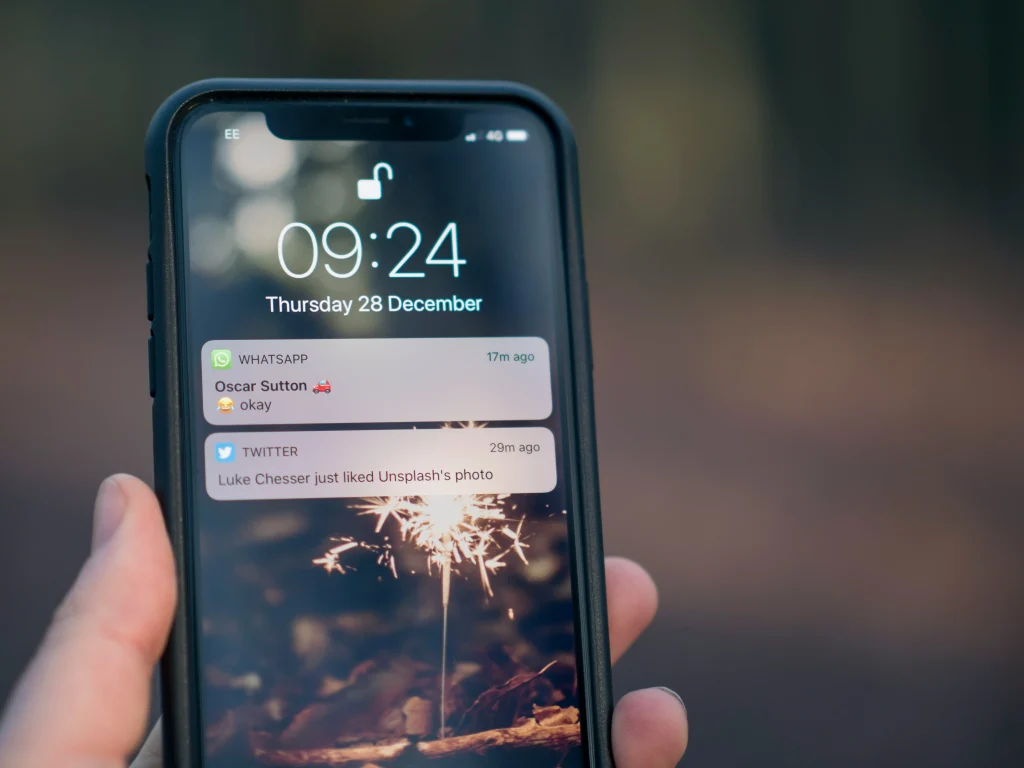
The introduction of rich notifications with images, quick action buttons, and direct replies has expanded the functional use of messages on the lock screen of mobile phones.
The standardization of Web Push APIs extended this ecosystem to browsers, allowing websites to deliver alerts without the need to install native applications.
Recent advancements have focused on personalization through artificial intelligence, intelligent grouping by relevance, and privacy tools that offer complete control over receiving alerts.
How do notifications affect user engagement and retention?
Relevant and well-targeted alerts significantly increase app open rates, keeping users engaged with mobility, delivery, and finance services.
Sending excessive amounts of irrelevant messages has the opposite effect, leading consumers to disable notification permissions or uninstall the application from their device.
Modern digital marketing strategies utilize behavioral segmentation to deliver messages at the exact moment when the user shows the greatest propensity to interact.
Read more: Developer verification on Android: what's changing?
Respecting user rest periods and offering granular preference settings have become indispensable requirements for building high-performance and reputable applications.
Rigorous technical specifications and reports on the information technology market can be found on the official website of Institute of Electrical and Electronics Engineers, a global authority in the field.
Revisiting origin of push notifications It demonstrates how engineering solutions focused on energy efficiency have managed to transform digital communication on a planetary scale.
The continuous infrastructure developed over the last few decades ensures that billions of alerts reach screens around the world safely and with millimeter precision.
What privacy and security challenges are involved in using push notifications?
End-to-end encryption has become a mandatory requirement in notification traffic to prevent the interception of sensitive data, such as bank codes and private messages.
Know more: Apps to check traffic fines directly from your cell phone.
Data regulations require platforms to request prior and explicit authorization from the user before sending any message of a commercial or informational nature.
The proliferation of attacks push phishing It forced browsers and operating systems to implement strict filters against malicious websites that attempt to induce clicks.
Developers and technology companies are continuously investing in improving authentication systems to ensure that credentials and identification tokens remain fully protected.
Conclusion
The creation of instant notifications represented a watershed moment in the history of mobile technology, enabling the ecosystem of modern applications that we use daily.
Read more: Set up Do Not Disturb mode to avoid daily interruptions.
Analyzing the technical journey of this innovation reveals how the optimization of hardware and network resources was crucial for the global popularization of smartphones.
The constant improvement of privacy and security policies ensures that this essential channel continues to evolve responsibly, efficiently, and with high value for society.
Frequently Asked Questions (FAQ)
Who invented the first push notification for mobile phones?
BlackBerry pioneered instant data delivery with push email in the late 1990s, but Apple popularized the modern format for applications in 2009.
Do push notifications consume a lot of phone battery?
No, the unified iOS and Android system maintains only one active, low-power connection, consuming significantly less energy than the older model of periodic checks.
What is the difference between SMS and push notifications?
SMS messages travel through the mobile network of operators, with costs per message, while push notifications use the internet connection through the operating system's central servers.