Why QWERTY keyboards still dominate the market today.
Adverts
Understanding the reasons why the QWERTY keyboards dominate Global digitization reveals a fascinating phenomenon of industrial standardization, collective muscle memory, and enduring technological hegemony.
Created in the 19th century to solve mechanical jams in typewriters, this layout has surpassed ergonomically superior competitors and adapted perfectly to modern smartphones and computers.
Analyzing the persistence of this pattern in 2026 demonstrates how the cost of transitioning to new formats outweighs the theoretical gains in speed, keeping the original structure unshaken.
How did the QWERTY layout come about, and what problem did it solve?
Christopher Sholes patented the key arrangement in 1868 with the practical goal of slowing down frequent letter sequences to prevent the mechanical rods from jamming.
Adverts
By separating common letter pairs in the English language, the inventor distributed the hand movement, allowing for smoother typing without interruptions caused by the mechanism jamming.
This initial mechanical engineering became the definitive commercial standard when the manufacturer Remington adopted the format in its mass-produced typewriters.
| Keyboard Layout | Year of Creation | Main Proposal | Global Adoption Level |
| QWERTY | 1868 | Avoid mechanical locking of rods. | Dominant (over 95% of the market) |
| Dvorak | 1936 | Reduce fatigue and increase speed. | Specialized niche and accessibility |
| Colemak | 2006 | Modern ergonomics while maintaining shortcuts. | Enthusiastic typing communities |
| AZERTY / QWERTZ | 19th century | Regional adaptation for local languages | Regional standard (France, Germany) |
Why have ergonomic options like Dvorak failed to replace the standard?
August Dvorak developed an alternative arrangement in the 1930s, positioning the most frequently used vowels on the center line to minimize finger displacement during use.
Ergonomic tests prove that alternative layouts reduce hand movement, but the percentage advantage in raw speed does not justify the painful relearning process.
The universal presence of the traditional format in schools, offices, and mobile devices discourages users seeking immediate efficiency in their digital routines from migrating to it.
Technical documentation regarding the standardization of human interfaces and ergonomics of input devices is maintained by International Organization for Standardization, an international standards body.
Understanding the reason why the QWERTY keyboards dominate Industrial production requires analyzing the network effect, where universal compatibility negates any isolated attempt at innovation.
In what ways have smartphones further consolidated this hegemony?
The transition from physical keys to touchscreens in the 2000s could have been the ideal time to introduce more efficient virtual layouts.
Read more: Do You Know These Secret Keyboard Shortcuts?
Manufacturers preferred to maintain the established design to ensure instant familiarity for users, integrating intelligent spell checkers and gesture typing to compensate for space limitations.
Typing with thumbs on small screens reinforced the convenience of the old visual map, making any layout change an unnecessary obstacle to the consumer experience.
Studies on human-computer interaction, digital usability, and the evolution of input peripherals are archived by Association for Computing Machinery, a world-renowned scientific institution.
What is the network effect and how does it prevent pattern changes?
Economists define the prevalence of this layout as the classic example of technological lock-in, where an established standard becomes viable simply because everyone uses it.
Schools teach the traditional method because the corporate market demands this skill, while manufacturers continue to produce compatible hardware to meet the established consumer demand.
Know more: Interesting facts about mechanical keyboards and their current popularity.
Breaking this vicious cycle would require a coordinated effort between governments, industries, and educational institutions, a scenario that is extremely unlikely given the satisfactory functioning of current technology.
Changing the default format would require reconfiguring universal software shortcuts like copy and paste, creating enormous friction in the daily productivity of millions of professionals around the world.
What is the future of typing in light of new input technologies?
Brain-computer interfaces, eye-tracking navigation, and advanced voice recognition are emerging as promising alternatives that may eventually reduce reliance on physical keys.
Even in modern corporate environments equipped with artificial intelligence, the physical keyboard remains the primary tool for accurate text production and software programming.
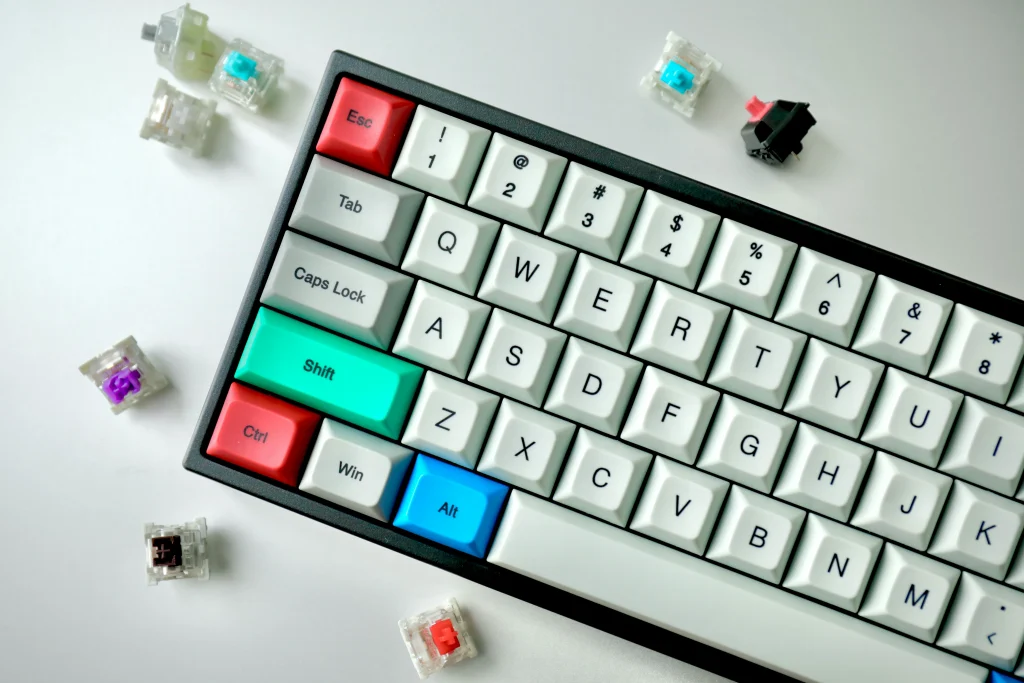
The durability of this century-old arrangement proves that simple and widely adopted solutions tend to withstand technological disruptions, continuously adapting to new digital platforms.
Read more: The F keys on the keyboard have functions that are rarely used today.
Preserving this standardization ensures global operational efficiency, connecting generations of users through an intuitive, stable, and universally recognized interface anywhere on the planet.
Frequently Asked Questions (FAQ)
Was the QWERTY layout designed to slow down human typing?
No, the original goal was to prevent the mechanical locking of neighboring strokes by alternating common letters to create a continuous typing rhythm without physical interruptions.
Is it possible to change the computer keyboard to the Dvorak standard?
Yes, most modern operating systems allow you to change the key mapping in the language settings for free, without needing to change the hardware.
Why do France and Germany use variations like AZERTY and QWERTZ?
These countries adapted the original arrangement to facilitate quick access to accents, cedillas, and high-frequency letters in their respective national languages without losing the structural basis.