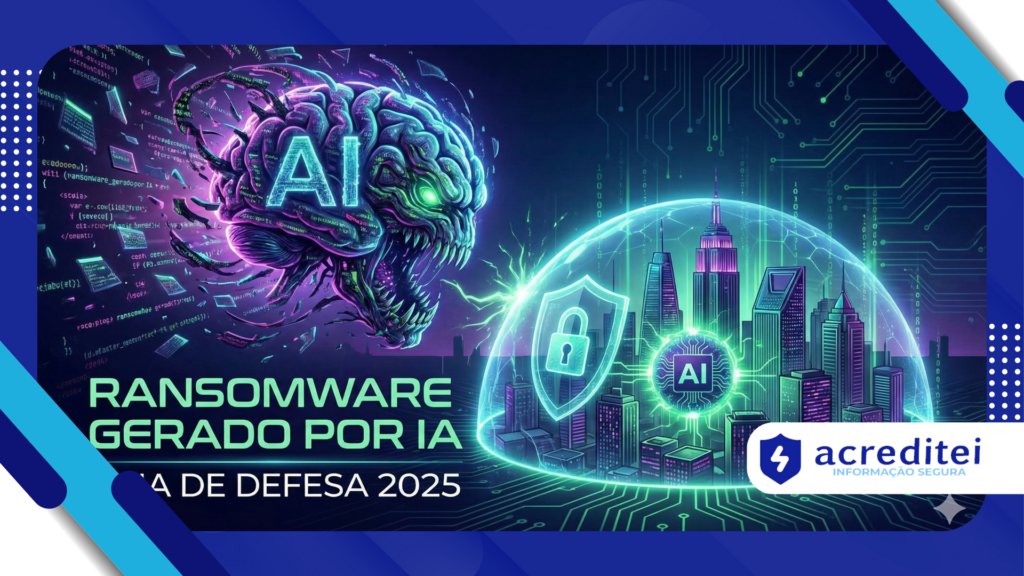
AI-generated ransomware and new types of attacks: a complete defense guide for Brazilian companies.
Adverts
The sophistication of digital threats has reached a new critical level with the popularization of AI-generated ransomware, challenging traditional defenses.
IT managers and business leaders are now facing algorithms that learn, adapt, and rewrite their own code to avoid detection.
The Brazilian scenario for 2025 demands a proactive stance, abandoning reactive security in favor of predictive and resilient strategies.
It's no longer just about protecting the perimeter, but about acknowledging that a breach is a constant possibility.
Adverts
This article dissects the anatomy of these new attacks and offers a practical roadmap for securing your corporate infrastructure.
The survival of the business depends on the ability to anticipate the moves of synthetic adversaries who never sleep.
Summary
- What is AI-generated ransomware and how does it differ from traditional attacks?
- Why have Brazilian companies become prime targets in 2025?
- How do polymorphic attacks and automated social engineering work?
- Comparative Table: Traditional Ransomware vs. AI Ransomware
- What defense strategies negate the advantage of Artificial Intelligence?
- What is the role of incident response and disaster recovery?
- Conclusion
- Frequently Asked Questions (FAQ)
What is AI-generated ransomware and how does it differ from traditional attacks?
O AI-generated ransomware It uses advanced language models to create unique malicious code in real time.
Unlike static malware of the past, these programs are able to modify their digital signature with each new infection.
This renders signature-based antivirus tools virtually useless against the new wave of cyberattacks.
Artificial intelligence allows malicious software to analyze the victim's environment before executing the encryption.
It identifies which files are most critical to the company's operation, maximizing the pressure for ransom payment.
Automation eliminates the need for a human operator to control each step of the intrusion.
Attacks have become faster, reducing the time between the initial intrusion and the complete encryption of data. What used to take days to execute now happens in a matter of minutes.
Furthermore, the barrier to entry for cybercriminals has decreased dramatically with AI-powered "Malware-as-a-Service" tools.
People without in-depth programming knowledge can launch devastating campaigns with just a few clicks.
+ Embedded technologies in budget-friendly home appliances
Why have Brazilian companies become prime targets in 2025?
Brazil has consolidated its position as one of the largest digital economies, but investment in security has not kept pace with this growth.
The accelerated digitization of financial and industrial processes has created a vast attack surface.
Many local organizations still operate with legacy systems, which have known vulnerabilities that have not been patched for years.
Cybercriminals are using AI to automatically scan the Brazilian internet for these specific vulnerabilities.
The widespread adoption of instant payment systems and digital banking attracts international gangs focused on quick financial gain.
The volume of digital transactions in the country is a magnet for data hijackers.
Another critical factor is the shortage of qualified cybersecurity professionals in the national market to monitor threats 24/7.
Small and overworked teams have difficulty identifying subtle anomalies generated by smart attacks.
The General Data Protection Law (LGPD) has increased responsibility for data breaches, raising the value of compromised data.
Attackers know that companies fear both the fine and the reputational damage.
How do polymorphic attacks and automated social engineering work?
Polymorphic threats are those that constantly change their code structure to avoid detection by security software.
O AI-generated ransomware It takes this to the extreme, completely rewriting itself with each execution.
This ability to mutate prevents defense systems based on known patterns from identifying the threat before it is executed.
The AI analyzes which evasion technique will work best against the specific antivirus installed on the target.
Meanwhile, social engineering has undergone a revolution with the use of voice and video deepfakes. Criminals clone the voices of CEOs to authorize urgent transfers or grant access via telephone.
Phishing emails, once riddled with grammatical errors and generic content, are now indistinguishable from legitimate corporate communications.
Language models analyze a company's tone of voice and create personalized, compelling messages.
These industrial-scale "Spear-Phishing" attacks target specific employees with privileged access to the network.
Personalization dramatically increases the click-through rate on malicious links or downloads of infected attachments.
+ The future of robotics and its growing presence in companies.
Comparative Table: Traditional Ransomware vs. AI Ransomware

Below, we present the structural differences that make the new threats so dangerous to today's corporate environment.
| Feature | Traditional (Legacy) Ransomware | AI-Generated Ransomware (2025) |
| Detection | Based on known signatures | Behavioral and predictive (difficult to detect) |
| Code Evolution | Static (same binary for all) | Polymorphic (code changes with each attack) |
| Phishing Target | Generic (bulk delivery) | Hyper-personalized (context-specific) |
| Action Speed | Days or weeks (manual recognition) | Minutes or hours (automatic recognition) |
| Human Interaction | High dependence on operators | Almost zero (end-to-end automation) |
| Defense Evasion | Basic and repetitive techniques | Real-time analysis of the target's defenses. |
What defense strategies negate the advantage of Artificial Intelligence?
Countering offensive AI requires the implementation of defensive AI integrated into security operations centers (SOCs).
Modern Endpoint Detection and Response (EDR) tools use machine learning to identify anomalous behavior.
The “Zero Trust” approach should be the architectural standard for any modern corporate network. Never trust, always verify, regardless of whether the connection comes from inside or outside the perimeter.
Multifactor authentication (MFA) must evolve towards phishing-resistant models, such as physical security keys (FIDO2).
Methods based solely on SMS or simple apps are easily circumvented by modern social engineering attacks.
Network segmentation is vital to prevent rapid lateral movement of a AI-generated ransomware. If a device is compromised, isolation prevents malware from reaching critical servers or backups.
User and Entity Behavior Analytics (UEBA) helps detect when a legitimate credential is acting suspiciously.
The system alerts if a finance employee attempts to access engineering databases in the early morning hours.
+ How to turn your smartphone into a productivity hub
What is the role of incident response and disaster recovery?
Even with the best defenses, cyber resilience requires a solid plan for when prevention fails. Immutable backups are the last line of defense against data hijacking and digital extortion.
Immutability ensures that backup files cannot be altered or deleted, not even by administrators.
This prevents ransomware from encrypting backups as well, ensuring a clean restore.
Data restoration tests should be performed quarterly to ensure data integrity and recovery speed.
Knowing that a backup exists isn't enough; you need to know how long it takes to restore the operation.
Tabletop exercises prepare management and the technical team for decision-making under pressure.
Determining who speaks to the press, who files insurance claims, and who shuts down the systems is crucial.
Transparent communication with clients and authorities, as required by law, should be included in crisis protocols.
Concealing the incident often results in greater financial and legal damage than the attack itself.
Conclusion
The emergence of AI-generated ransomware This marks a turning point in the history of global information security.
Attack tools have become accessible, intelligent, and ruthless, requiring a reinvention of corporate defense strategies.
For Brazilian companies, the challenge is twofold: modernizing technological infrastructure and training teams to resist digital psychological manipulation.
Technology alone will not solve the problem if the human factor continues to be the weakest link.
Investing in threat intelligence and defensive automation is no longer a luxury, but a business continuity requirement.
Only organizations that can respond at machine speed will survive the hostile environment of 2025.
Frequently Asked Questions (FAQ)
Does standard antivirus software protect against AI ransomware?
Not entirely. Traditional antivirus programs look for signatures of known viruses. Because AI creates new code with each attack, it's necessary to use advanced solutions. EDR/XDR with behavioral analysis.
What is an immutable backup?
It's a backup copy that, once saved, cannot be modified or deleted for a specified period. This prevents ransomware from destroying the backup during an attack.
Are small businesses also targets of these attacks?
Yes, frequently. Cybercriminals use automation to attack smaller targets en masse, as these often have weaker defenses, serving as an entry point into larger supply chains.
How to identify an AI-generated phishing email?
It's difficult, as the grammar is usually perfect. Be wary of excessive urgency, verify the actual sender (header), and confirm unusual requests through another communication channel (phone or internal chat).
Is it worth paying the ransom for the data?
Experts and authorities recommend not paying. Payment does not guarantee the return of the data, it finances crime, and it marks the company as a "payer," attracting new attacks in the future.